The Strike
It started with a post. One post. And within hours, it became a digital wildfire.
Stephen Miller, the architect of some of the most controversial immigration policies in modern American history, decided to share his thoughts on Star Trek. He praised Patrick Stewart. He called for the “reconciliation” of William Shatner with the franchise. And he did it all with the confidence of a man who believed he was on the right side of history.
The internet responded with a resounding: Are you kidding?
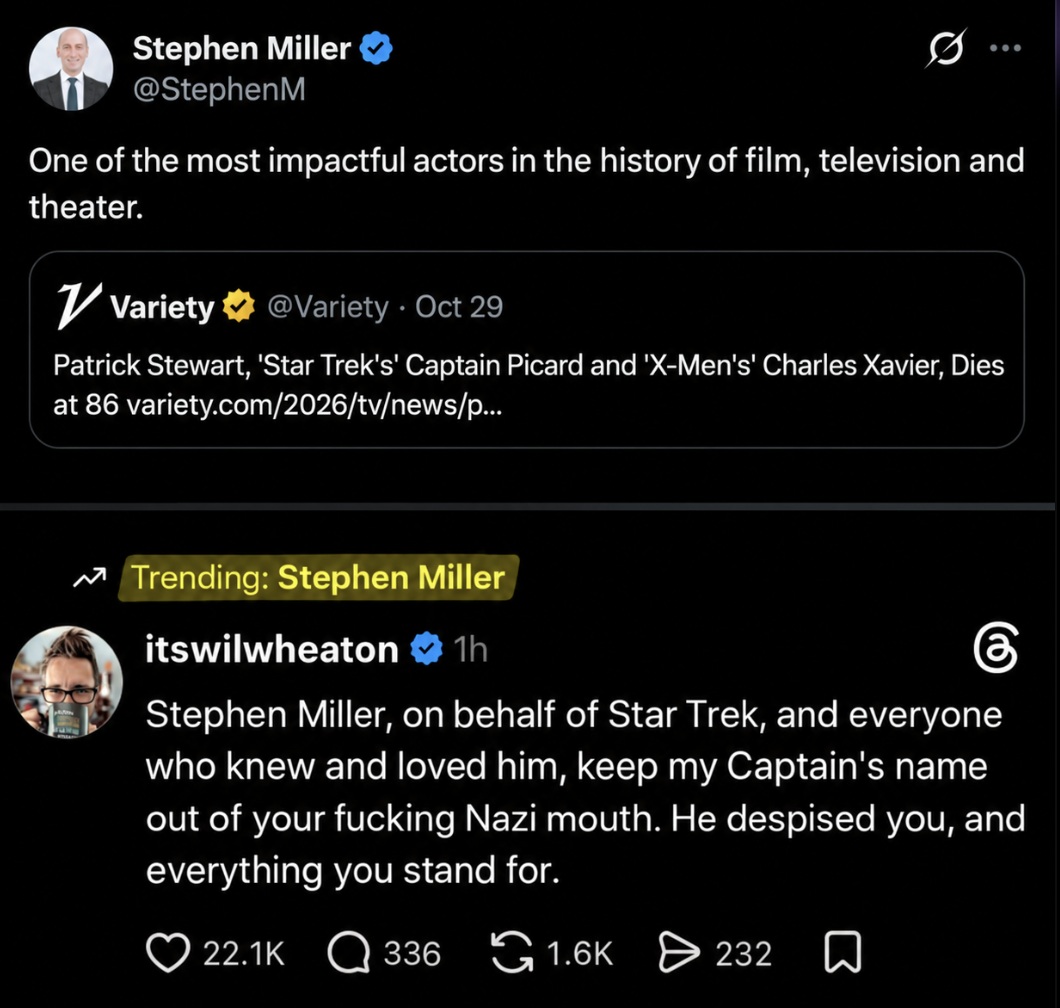
Within hours, the post had thousands of replies. Most of them were not kind. The quote was shared widely, often with a single comment: “Stephen Miller watched Star Trek and somehow thought he was on the good guys’ side.”
That line, posted by @ash.renee411, became the battle cry. It racked up nearly 19,000 likes and hundreds of reposts. It was a perfect distillation of the absurdity: a man whose policies have been compared to authoritarianism, aligning himself with a show that celebrates diversity, diplomacy, and the triumph of hope over fear.
The Threat
But this wasn’t just a random hot take. It was a window into a deeper delusion.
Miller’s comment about Shatner revealed a fundamental misunderstanding of Star Trek’s ethos. He seemed to believe that the original series, with its white male lead, was the “real” Star Trek—and that modern iterations had strayed too far into “woke” territory. He wasn’t alone. Many on the right have long claimed Star Trek as their own, ignoring its core messages of inclusion and progress.

Wil Wheaton, who played Wesley Crusher on Star Trek: The Next Generation, didn’t hold back. He quote-tweeted Miller’s post with a simple, devastating reply: “You are not on the good guys’ side.” The post went viral, with fans praising Wheaton for speaking truth to power.
But Miller’s delusion went deeper. His praise for Shatner was also a dog whistle. Shatner, who has a history of controversial statements, had recently complained about not being invited back to the franchise. Miller’s call for “reconciliation” was a thinly veiled attack on the current Star Trek leadership, which has embraced diversity and progressive storytelling.
The irony was lost on no one: Miller, a man who has spent his career demonizing immigrants and minorities, was trying to claim the legacy of a show that literally features a multi-ethnic crew working together for a better future.
The Trump Card
Then came the twist that no one saw coming.
As the backlash grew, an old interview resurfaced. In it, Miller was asked about his favorite Star Trek episode. His answer? “The one where Kirk fights the Gorn.” A classic episode, sure—but also one where Kirk outsmarts a lizard-like alien by using his wits, not violence. The episode is often cited as a metaphor for the Cold War, with Kirk representing diplomacy and restraint.

The irony was brutal. Miller, the man who built his career on fear and division, was citing an episode about empathy and understanding. The internet exploded again. Memes flooded timelines. Fans pointed out that the Gorn were misunderstood, and that Kirk’s victory came from seeing them as more than just monsters.
But the real trump card came from the Star Trek community itself. In a rare move, the official Star Trek account tweeted a clip from The Next Generation, featuring Captain Picard’s famous speech about the rights of all sentient beings. The caption: “We believe in infinite diversity in infinite combinations. Always have. Always will.”
It was a subtle but clear rebuke. Miller’s attempt to claim Star Trek had backfired spectacularly. The franchise wasn’t his. It never was.
The Moral Question
In the end, the saga of Stephen Miller and Star Trek is more than just a Twitter spat. It’s a reminder that stories matter. They shape how we see the world and our place in it. Miller saw himself as a hero because he misunderstood the story. But the true heroes of Star Trek are those who fight for a future where everyone belongs.
So here’s the question: If you can watch Star Trek and still think Stephen Miller is on the good guys’ side, maybe you’re watching it wrong. Or maybe you’re just not watching at all.