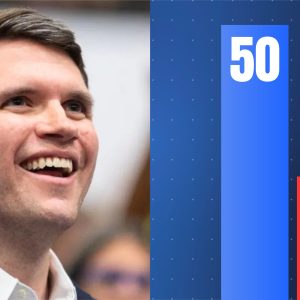
The headline looks like a political earthquake. Democrat David Jolly is officially TIED with MAGA Byron Donalds, suggesting Florida is suddenly back in play. But the real story is not just about who wins the governor’s mansion. It is about whether Florida is genuinely shifting, or if this is a strategic trap designed to force the GOP to burn millions in a state they thought was permanently secure.
For the last few election cycles, Florida was written off by national strategists as an impenetrable conservative fortress. The assumption was that the state’s political infrastructure was so heavily tilted that any high-profile Republican would coast to victory. The fact that a deadlocked poll exists this late in the game shatters that aura of invincibility.
If Byron Donalds is genuinely stalled at 45%, it exposes a critical vulnerability. It suggests that while the MAGA brand dominates primary elections, it may have a hard ceiling when it comes to a general electorate. By running a polarizing, base-first campaign, Donalds may be struggling to capture the exact suburban and independent voters that a moderate-leaning Democrat like Jolly is explicitly targeting.
This creates a massive leverage problem for the Republican party. Defending Florida is astronomically expensive. The state features multiple massive, high-cost media markets. If the GOP is forced to suddenly dump tens of millions of dollars into Tampa, Orlando, and Miami just to save a race they assumed was locked, those are dollars instantly drained from other tight battlegrounds across the country.
This is where the tension lies. Democrats are treating this poll as proof of momentum. But political history is littered with October polls showing Democrats tied in Florida, only for the Republican turnout machine to deliver a crushing reality check on Election Day.
There is another way to read this: it may be a mirage. Critics will argue that tied polling is just a tool to generate Democratic fundraising hype. They believe that when the final votes are cast, the structural Republican registration advantage will easily overwhelm Jolly’s moderate appeal, rendering the current panic meaningless.
But perception creates its own reality in politics. Even if Donalds ultimately pulls ahead, the optics of a MAGA star fighting for his political life against a Democrat in Florida damages the narrative of absolute control. It forces Republicans to play defense on their home turf.
The uncomfortable question is not just who wins the final vote tally. It is who benefits most if the tension never fully ends. For Democrats, bleeding the GOP’s war chest in Florida is a strategic victory in itself. For Republicans, the failure to put this race away early is a warning sign nobody wants to acknowledge out loud.