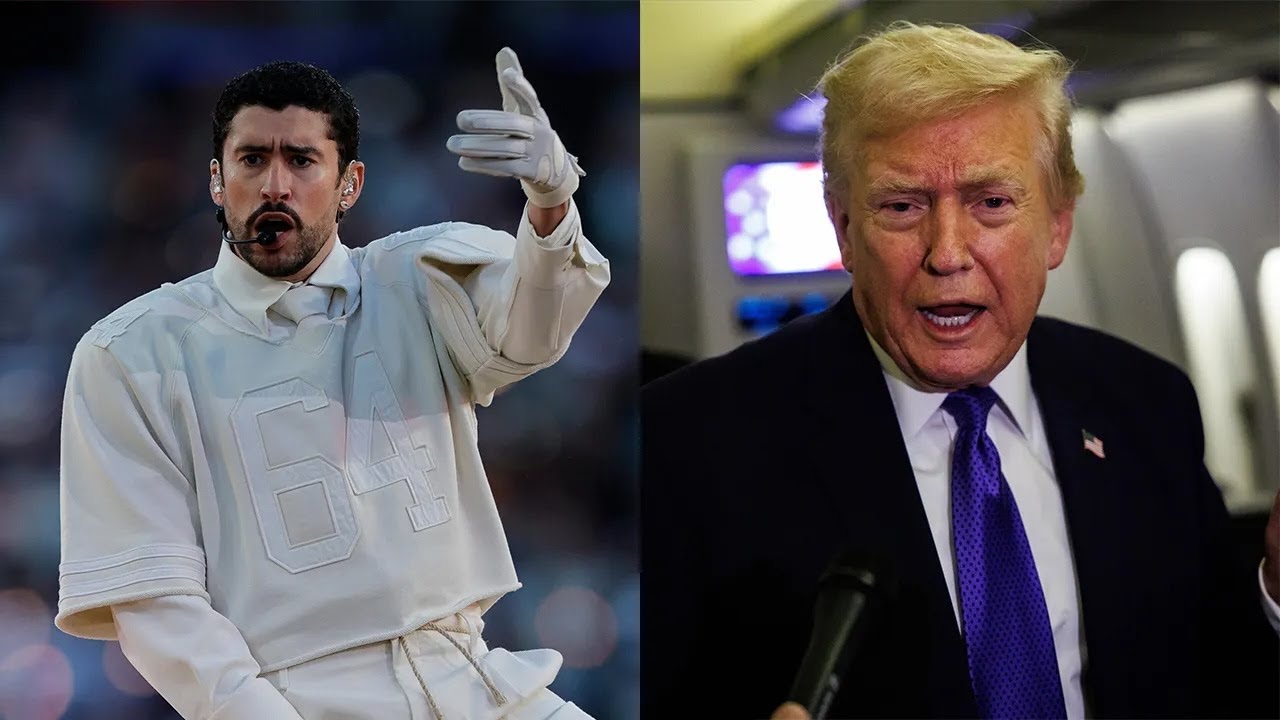
Bad Bunny’s Super Bowl halftime performance was designed as a celebration of unity, culture, and joy. Instead, it triggered a wave of outrage from MAGA-aligned figures—including Donald Trump himself—revealing a deepening cultural divide over what “America” is, and who gets to define it.
The performance opened with a sweeping roll call of countries across Latin America and the Caribbean—Chile, Argentina, Uruguay, Colombia, Mexico, Puerto Rico, and more—before culminating in a simple but unmistakable message displayed behind him: “The only thing more powerful than hate is love.” On the football Bad Bunny carried across the stage were the words: “Together, we are America.”
It was an uplifting, celebratory ending to a widely praised performance. Even viewers who did not understand the lyrics could feel the emotion, the rhythm, and the communal energy. For many, it was joyful. For others, it was inspiring. Some even described it as patriotic in the most inclusive sense of the word.
But not for MAGA.
From celebration to manufactured outrage
Almost immediately, conservative commentators and Trump allies reframed the performance as a political provocation. What many saw as a tribute to togetherness, they characterized as anti-MAGA messaging wrapped in cultural expression.
One of the most repeated complaints was that the performance was “not in English.” A Forbes–Tucker Carlson–linked publication even ran a headline asking, “What did Bad Bunny say at the Super Bowl halftime show?” before answering its own question: “Not one word of English.”
The irony was not lost on critics. The same figures who regularly air untranslated clips of Vladimir Putin without complaint suddenly demanded linguistic purity when Spanish took center stage at the Super Bowl. Notably, Bad Bunny did say *“God Bless America”—*three English words—but for MAGA critics, that was apparently not enough.
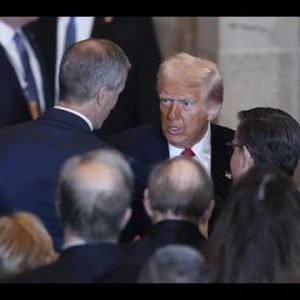
Donald Trump himself joined the backlash, posting on social media that the show was “one of the worst ever” and insisting that “nobody understands a word the guy says.” This, critics noted, came from a politician whose own speeches are often mocked for their incoherence.
Competing ideas of offense—and patriotism
Trump’s reaction was particularly striking given his refusal, just days earlier, to apologize for sharing a now-deleted racist video portraying Barack and Michelle Obama as apes. When pressed by reporters aboard Air Force One, Trump deflected responsibility, claiming he had only seen “the first part” of the video and suggesting someone else had posted it on his behalf. He offered no contrition, insisting he had made no mistake.
The contrast highlighted competing definitions of what constitutes an “insult” to the nation. For many Americans, racist imagery aimed at former presidents crosses a clear moral line. For Trump and his allies, however, a Spanish-language performance celebrating unity was somehow more offensive.
Culture as a battleground
Political journalist Adrienne Carrasquillo described watching the halftime show with a “permanent smile,” while also anticipating the backlash. She noted that while Bad Bunny’s Grammy appearances were explicitly political, the Super Bowl performance was allowed to simply be art—fun, celebratory, human.
Yet that humanity itself appeared to be the problem.
According to Carrasquillo, the performance affirmed dignity and belonging at a time when the Trump-aligned political movement has repeatedly questioned the humanity of immigrants, Latinos, and even U.S. citizens who do not fit its narrow vision of American identity. The message of unity—together, we are stronger—runs directly counter to the politics of exclusion.
Notably, Bad Bunny was not a rogue choice. He was selected by the NFL, an institution long perceived as conservative and closely aligned with MAGA-leaning owners. That decision alone signaled a shift. The league understands where its audience—and its future growth—lies: a diverse, global, multilingual fan base.
A broader pattern of resistance
The backlash also fits into a wider cultural moment. Athletes, artists, and public figures—many with little to gain politically—have increasingly spoken out against Trump-era rhetoric. Olympians such as Chloe Kim and Eileen Gu have publicly rejected Trump’s attacks, emphasizing that sports exist to bring people together, not divide them.
This cultural resistance stands in contrast to institutions—law firms, universities, tech executives—that critics say capitulated out of fear. In that context, Bad Bunny’s performance was not just entertainment; it was a reminder that culture still has a spine.
Why it rattled Trump
At its core, the outrage revealed something deeper: a crack in Trump’s projection of cultural dominance. Despite his obsession with portraying himself as an apex figure in American life, the Super Bowl demonstrated that he is not more powerful than popular culture—and not more powerful than Bad Bunny.
That realization, critics argue, fuels the panic underlying the backlash. As James Baldwin once wrote, America must “crack open the image” it presents to see what it hides. What often lies beneath is fear—fear of diversity, of change, of a reality that contradicts a carefully constructed myth.
The sounds, tastes, and rhythms of America tell a different story. They reflect a country shaped by diversity, not threatened by it. Bad Bunny didn’t invent that truth—he simply put it on the biggest stage in the world.
And for some, that was unforgivable.