Three amateur palaeontologists have discovered the remains of a 100-million-year-old long-necked marine reptile at an outback Queensland station.
In an Australian first, the complete skeleton of an ancient plesiosaur, or extinct marine reptile, was discovered at a sprawling remote property in the McKinlay region.
The rare fossil was discovered by a station owner, Cassandra, alongside fellow amateur fossil sleuths Sally and Cynthia, known as the ‘Rock Chicks’.
The discovery has been described as the Rosetta Stone of marine reptile palaeontology, a reference to the ancient carved stone discovered in Egypt in 1799 and considered to hold the key to deciphering Egyptian hieroglyphics.
A team of museum palaeontologists travelled to the remote site to collect the fossil of the elasmosaur, a plesiosaur that lived alongside the dinosaurs.
The Elasmosaurus lived in the Eromanga Sea, which covered large parts of inland Australia between 140 and 100million years ago.
The recovery was led by Queensland Museum Network Senior Scientist Dr Espen Knutsen, who said the remains were the first known head and body of an Australian elasmosaur to be held in a museum collection.
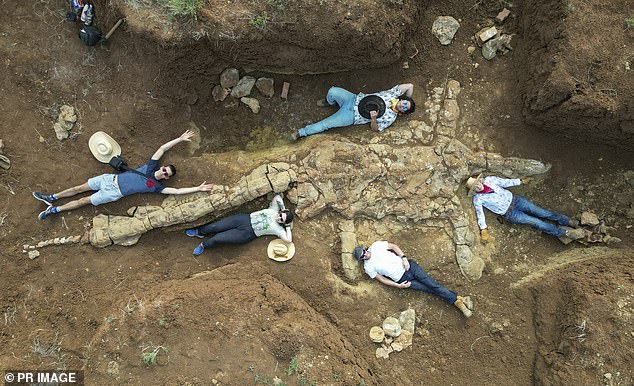
A team of museum palaeontologists travelled to the remote site to collect the fossil of the elasmosaur, a plesiosaur that lived alongside the dinosaurs
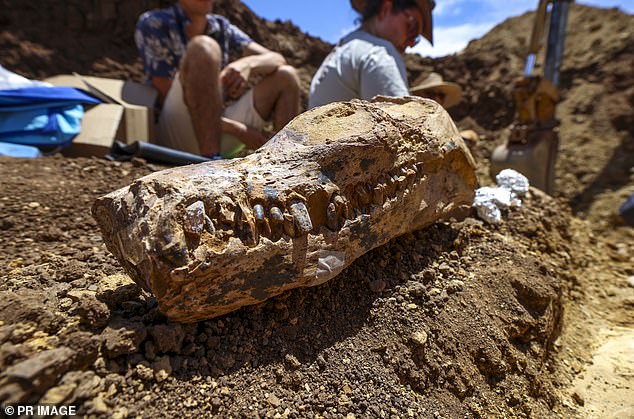
The remains are the first known head and body of an Australian elasmosaur to be held in a museum collection
‘We were extremely excited when we saw this fossil – it is like the Rosetta Stone of marine palaeontology as it may hold the key to unravelling the diversity and evolution of long-necked plesiosaurs in Cretaceous Australia,’ Dr Knutsen said.
‘We have never found a body and a head together, and this could hold the key to future research in this field.
There are well over a hundred species of plesiosaurs currently known worldwide – some had long necks and small heads, and some had short necks with giant heads.
Elasmosaurus came to the water’s surface to breathe air and had slender teeth for catching fish, crabs and molluscs.
Scientists have discovered plesiosaur fossils with stones (called gastroliths) in the stomach area, showing they swallowed them to either grind up food in their stomachs or as ballast to aid in diving.
Queensland Museum Network CEO Dr Jim Thompson said the find would help paint a comprehensive picture of Queensland’s Cretaceous marine reptiles.
‘We now hold the only head and body of an Australian elasmosaur in the world, and this significant find will contribute greatly to vital research into Queensland’s Cretaceous past,’ Dr Thompson said.
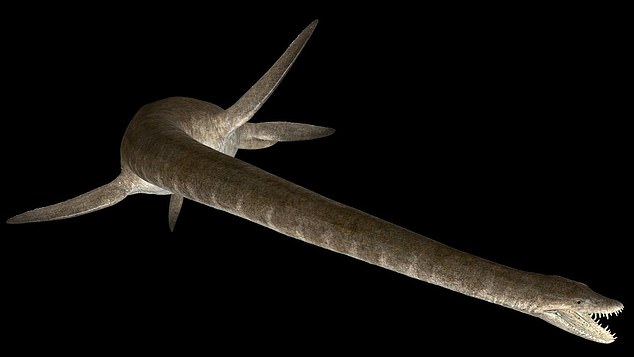
The Elasmosaurus lived in the Eromanga Sea, which covered large parts of inland Australia between 140 and 100 million years ago
‘Queensland Museum Network holds one of Australia’s most complete plesiosaur specimens, nicknamed ‘Dave the Plesiosaur’, which was discovered in 1999, however despite having 80 per cent of its bones, it was missing a head, fins and tail tips.’
Along with the new skeleton, the remains of plesiosaurs and ichthyosaurs were discovered and collected on the field trip, which will be transported to Townsville for preparation and further research.
The find is one of the biggest discovered by amateur palaeontologists the Rock Chicks, who have walked hundreds of kilometres on their quest to uncover fossils which include a plesiosaur each, a kronosaurus, an ichthyosaur and several fish and turtles.